Marvel Comics has the optimisation sickness
A look at what has gone so badly wrong at Marvel's comics publishing arm
When I first started writing and publishing science fiction stories I had a sort of cringe around telling people about it. Telling people you're a writer is, in my head anyway, analogous to telling them you're a footballer. They're going to want to know how to take that: are you someone who plays every weekend in front of thousands of people, or do you just join pick-up games once in a while at the park?
It's probably pretty easy to determine if someone you're talking to is a professional athlete, but in the case of a writer, unless you're going to break off the conversation and read their book, how do you tell if they're part of the fairly small proportion of writers who are any good at it?
Because of the ambiguity of this scenario, writers, when they're introducing themselves socially or in their author bios, use a few available shorthands:
- Sales. "My novel made the USA Today bestseller list."
- Awards or nominations. "I've been a finalist for the Hugo Award for Best Novel twice."
- A Hollywood sale. "My fantasy trilogy is being developed for television by HBO."
- Critical acclaim. "My short story collection was included in the New York Times Book Review's 10 Best of 2025 list."
There are some other possibilities around the edges, like social media popularity. "My short story went viral on Twitter" used to be a thing people could say.
None of these shorthands necessarily show that a writer's work is any good. They do show that someone other than the writer cares about it, which is sort of related. They're a bunch of objective measures that let you draw a vague conclusion about a subjective thing.
C. Thi Nguyen recently published an incredible book, The Score, which is about situations like this. When it's difficult to assess what exactly it means for something to be good, but there is some sort of flawed but objective measure you can use in place of a pure value judgement.
The problem, Nguyen says, is that if you start to assess yourself against a "number go up" type of metric, there's a risk that the things that make the number go up end up becoming your entire personality. Nguyen calls this Value Capture, but that doesn't make for a good headline, so I'm calling it Optimisation Sickness. You see it all over the place.
Some examples:
Billionaires intent on making more money. Don't they already have more than they could ever need? Doesn't matter! The metric has become their personality. Number go up!
Social media users who get more engagement with those ~spicy takes~ so the takes get spicier and spicier until spiciness is all that's left because the user has a galloping case of Poster's Disease.
Politicians whose personality is whatever the opinion polls say, because they're desperate to appeal to a median voter who may not even exist.
Marvel Comics, which runs its comics line into the ground because it can't stop trying to squeeze every available dollar from its existing customer base.
Okay, I got there eventually. Let's talk about Marvel Comics.
I am a Marvel Comics fan. I prefer the Marvel characters and the Marvel Universe to their equivalents at DC Comics. When I first developed a weekly comics habit as a teenager, probably nine out of every 10 books I bought were Marvels. Spider-Man, Captain America, Thor, Iron Man, Fantastic Four. Later branching out into Daredevil and The Avengers and the X-Men books.
I'm biased towards Marvel. Which I think gives me some authority to say that the current Marvel Comics line is awful, much worse than DC's, and has been for some time.
But I started this essay by talking about how the quality of creative work is a subjective judgement. Can we really say Marvel comics are currently bad?
In my view, yes. Much in the same way that fans of the MCU movies will tell you that the franchise has gone off the boil since Avengers: Endgame in 2019. I don't think you can judge strictly by sales, although DC's hits are currently more popular than Marvel's hits. Maybe in combination with things like the recent ComicsPRO retailer event, which was reportedly a rousing success despite almost no one who attended having much positive to say about what Marvel is currently publishihg.
But let me try to set up a sort of standard, which I'll illustrate with an anecdote.
Last year I was in Los Angeles for a few days and I went, as I always do when I'm in an unfamiliar city, to some comic stores. One place I found myself was an incredible eccentric downtown location called The Last Bookstore, which mostly sells other types of books but has a little room dedicated to comics. While I was browsing in there, two other guys came in. I would say they were fairly bro-ish, around 30 years old. I wasn't trying to eavesdrop but in those close quarters it was practically unavoidable. They proceeded to have the following exchange:
BRO 1: Dude, did you read Watchmen?
BRO 2: Yeah, I read it.
BRO 1: Have you read these? Frank Miller’s Daredevil run. You have to read it.
BRO 2: Do you have any Spider-Man recs?
Now I have read plenty of Spider-Man comics but I genuinely didn't know what single run or storyline would be recommended here. I asked the groupchat later and most people guessed wrong.
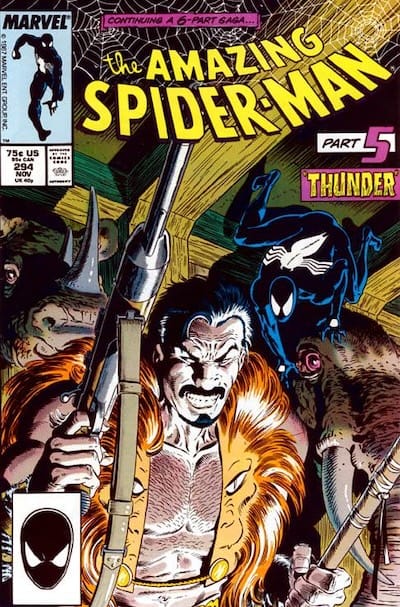
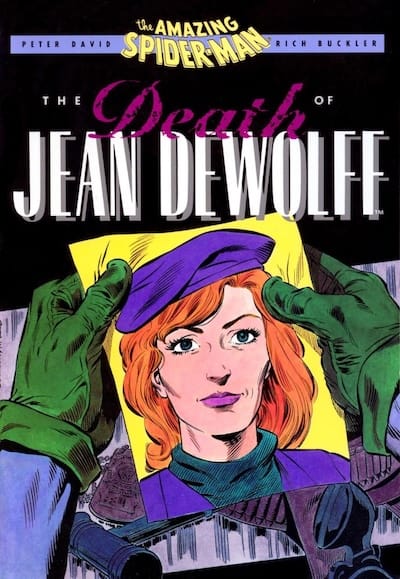
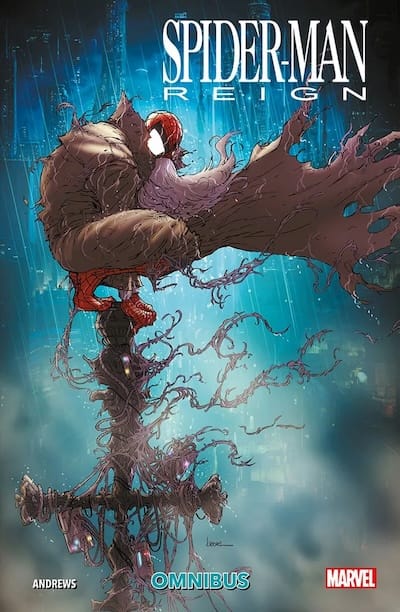
Three plausible Spider-Man storyline contenders: Kraven's Last Hunt, The Death of Jean DeWolff, and Spider-Man: Reign. Art and characters (c) Marvel.
I'll save you the suspense: Bro 1 recommended The Superior Spider-Man. That being the 2013 storyline where Peter Parker dies and his body, mind and superhero identity are taken over by his archnemesis, Dr Octopus.
I feel it’s important to point out that I don't like that story. I haven't read all of it and I probably never will. It's just not what I'm looking for in a Spider-Man comic. But based on how much online discussion of it there was as it was being published and the fact that people are still recommending it as a back catalogue highlight over a decade later, I can't deny that it worked for a lot of the audience. It took the character in a different direction. Made its mark on the Spider-Man canon, if you will.
Similarly, I know X-fans who never liked the Krakoa storyline, Hawkeye fans who didn't take to the Fraction/Aja run, Daredevil fans who were against what Brian Bendis did with the character. All of which is fine! But I want to separate out the individual taste element from the idea that these were distinct approaches that tried to bring something new and had a degree of creative vision behind them.
If the current Marvel publishing slate was full of things like those, I wouldn't be writing this post. But it isn't. What it is full of is what the groupchat calls IP dice rollling. It’s like you’re rolling two dice, one where the sides are character names and the other where the sides are powers. So you get "Wolverine, but his head is on fire like Ghost Rider." Or "the Green Goblin, but he gets the Carnage alien costume."
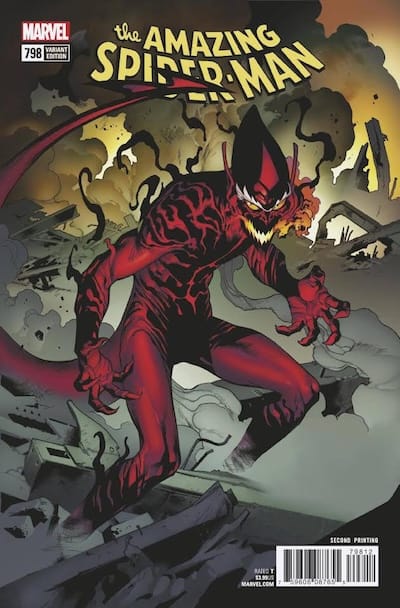
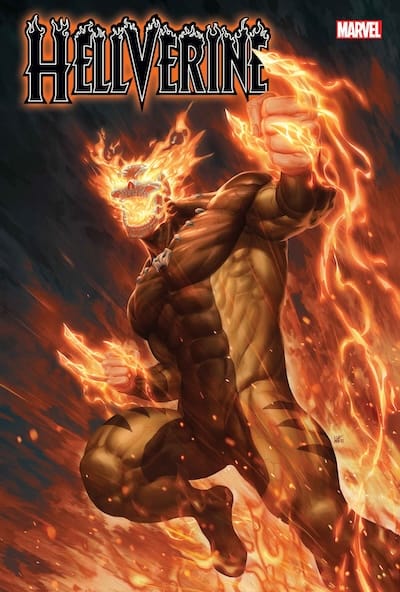
Cover images featuring The Red Goblin and Hellverine. Art and characters (c) Marvel.
I have a Marvel Unlimited subscription, but since at this point the only Marvel book I'm reading every issue is Ryan North's Fantastic Four, I mostly depend on hearing other people's recommendations to prompt me to read other series. Last year I went months without even remembering to open the app.
But I opened it just now and scrolled through the most recent issues. A couple of characters had become zombies. A couple were possessed by demons or cosmic entities. A few had swapped costumes: X-23 is calling herself Sabretooth, and a version of the old X-Men enemy Wendigo is wearing the Wolverine costume. The Green Goblin is in a Spider-Man suit. Eddie Brock, best known as the human identity of Venom, has become Carnage. The human in the Venom suit is currently Mary Jane Watson, former Spider-spouse. Dr Strange lives in Asgard now.
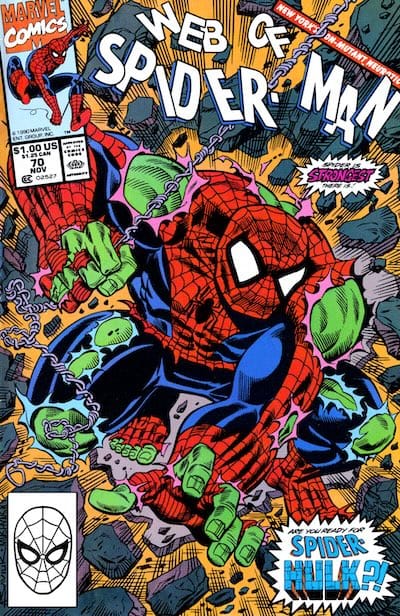
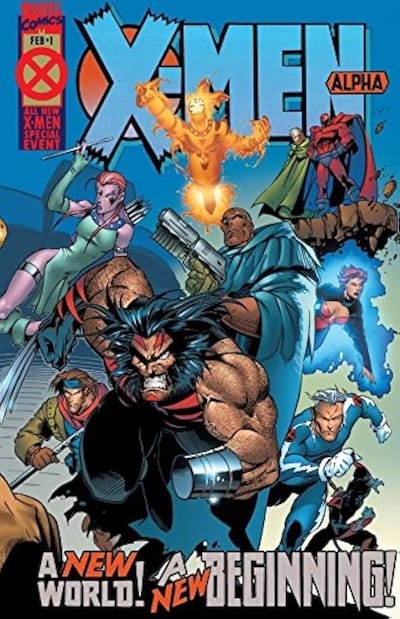
Spider-Hulk, a one-off character mashup that appeared for two issues in the 90s. This sort of thing is now one of Marvel's two standard storylines, the other being revivals of old crossovers, like Age of Apocalypse. Art and characters (c) Marvel.
It's all superhero madlibs. It's all crossovers and mashups. Half the books feel interchangeable, without the space to become their own thing. I know the Superior Spider-Man story might seem superficially similar to some of this, but "what happens when a villain gets the life of a hero" feels like a story that might be about something. Most of what I saw just now looked like convoluted fanservice generated by rolling the IP dice.
The line-wide crossover is great for producing a short-term sales boost, but it's a difficult format for telling a story that's actually about something.
But it is possible. I think House of X/Powers of X, the opening salvo of the Krakoa storyline, is one of the most incredible comics Marvel has published this century. It's now clear, I think, that writer Jonathan Hickman came to the X-books with a lot of big ideas and an intention to tell a complete story.
Unfortunately for him, his story was a big commercial hit, someone at Marvel saw dollar signs and decided not to let it end, leading to Hickman walking off the books halfway through and the storyline collapsing in an over-padded, anticlimactic mess.
It's not like this is the first time a comics publisher has milked a popular story to death, but the standard is usually to let creators do something good before strip-mining their work.
Like you wait until you have a volume of Watchmen that's a perennial backlist seller, then you put out Before Watchmen and have the characters cross over with the DC Universe in Doomsday Clock and publish a 12-issue Rorschach spin-off. If DC in the 80s had operated the way Marvel is being run now they'd have had Rorschach joining the Justice League by the time Watchmen issue 6 was on the stands.
So having a successful series at Marvel is a problem. But so is having a series that's not successful enough. Hickman's Imperial storyline, an attempt to reinvigorate Marvel's cosmic characters, is being wound down early, apparently due to disappointing sales.
I'm largely indifferent to the cosmic characters but I like Hickman's work, so I was tentatively interested. But the storyline involved five spin-off titles plus a crossover tie-in with the main Spider-Man book and I frankly wasn't that interested.
The current status quo at Marvel seems to be that if a storyline is successful they'll publish too many comics about it and it will get derailed. If a storyline isn't successful enough they'll publish too many comics about it and it will get derailed.
Why does everything at Marvel have to be the biggest, most exhausting possible event? Why is it impossible for them to exercise some restraint and let anything grow?
Industry figures have begun to mutter darkly about conspiracies, but I don't think there's anything that can't be explained by simply looking at how Marvel Comics has operated as a business.
To understand why Marvel is this way, it might be worthwhile to recall how we got here. As long ago as the 1940s, when it was still called Timely Comics, Marvel had a reputation as the company that hunted for trends so it could flood the market with cash-in titles. Marvel was a financially precarious operation that nearly went out of business multiple times: when its distributor lost an antitrust case and vanished in the 1950s (until Jack Kirby, Steve Ditko and Stan Lee put it back on firmer footing by creating a new superhero line); when newsstands were in decline in the late 1970s (saved, so the story goes, by the company securing the comics license for Star Wars); and yet again in the 1990s, when the comics speculator bubble collapsed and yet another distributor crashed and burned.
And that time, what saved the company was being bought out of Chapter 11 bankruptcy by its toy manufacturer, owned by Isaac Perlmutter.
To give credit to the Trump-affiliated billionaire – something I'm not really inclined to do – when Perlmutter took over, Marvel had spent a couple of years being eyed up by corporate raiders and looking like it might need to be shut down and sold off for parts. And by the time he finally left, almost exactly three years ago in 2023, the company had been bought by Disney and firmly incorporated into the Disney ecosystem, its characters household names.
Perlmutter's fervour for cost-cutting is the stuff of legend. His greatest hits include: rescuing paperclips from the office trash so they could be reused; refusing to pay for toilet paper in the staff toilets; and not allowing Marvel to pay for a booth at conventions so they could promote their comics.
Maybe you can make a case that extreme cost-cutting made sense when the company was teetering on the edge of no longer being a going concern (although basic sadism is also a possibility in this case, you'd think). But now that it's part of one of the world's biggest entertainment conglomerates? No.
When Perlmutter was ousted from running Marvel Television in 2019 it led to dramatic changes in the way the division operated. Marvel's television division went from producing inexpensive fare like the Netflix Daredevil and the infamously cheap-looking ABC Inhumans show to making Secret Invasion, a six-episode streaming miniseries that cost $212 million. It was also absolutely dreadful, I'm not necessarily arguing that this was a uniformly good change, but it was a big change.
To iris in on the comics division, Perlmutter took control of it in 1998. He ran it until the acquisition by Disney, over a decade later. And then he continued to run it in basically the same way for nearly 15 years as a Disney subsidiary. Since he left, the company has not had a much-needed reset.
I broke myself of the habit of buying physical single issues years ago, but according to people who still buy them, these supposed collector's items feel cheap now. I can confirm that Marvel's trade paperback editions are overpriced, flimsy and unappealing. Thanks to Perlmutter's ban on the company carrying inventory, it has been unable to keep its backlist consistently in print for as long as I can remember.
So Marvel has been being run like a company fresh out of bankruptcy proceedings for nearly three decades now.
And for a publisher in their current position to be so motivated by the monthly bottom line makes zero sense.
Now, maybe some of you are Milton Friedman-pilled and neoliberalmaxxing enough that you're saying "Well of course a company needs to make the biggest possible profit, that's capitalism baby!!"
First of all, the company that we're talking about isn't actually Marvel Comics. We're talking about The Walt Disney Company. Marvel is several layers down in the corporate hierarchy, under Disney Publishing. Disney as an overall conglomerate is a publicly-traded company, so by convention it has to care about maximising profits.
But the main contribution Marvel makes to the Disney profits is through the intellectual property it provides for the theme parks and the movies and the tv shows and the merchandising sales. And in order for that intellectual property to be valuable, people have to find the Marvel characters appealing. The comic book division, whose profits amount to, from Disney's point of view, approximately chicken feed, is an inexpensive way to generate new ideas and approaches that keep their characters from feeling stale. Even from a purely mercenary viewpoint, it’s in Disney’s best interest to have a healthy Marvel Comics.
Let's look at what's happening at DC for instance, DC being Marvel's main competitor and in a similar situation in the sense that it’s also just one part of a much larger corporate entity.
The quality of DC's comics line has been pretty variable over the years since they launched the New 52 initiative, a 2011 line-wide continuity reset. The comics published as part of the New 52 were, allowing myself to editorialise for a moment, largely worthless. I wouldn't add this if it was just my opinion, but I think it's a fairly widespread view.
In its favour, the New 52 did provide an entry point for readers who weren't already regular customers of the specialist retailers of the Direct Market, drilled and skilled in the ways of the weekly comics purchase.
And providing an easy on-ramp has remained a focus for the company up to the present, more readable era led by editor-in-chief Marie Javins. At least part of their line can be followed by readers who don't have a graduate-level understanding of their continuity, and can be repackaged into trade paperback volumes and sold to casual fans.
Currently DC's most high-profile titles are the Absolute line, intentionally unhinged alternate takes on some of DC's most popular characters. These are aimed in part at people who enjoy manga series like Chainsaw Man. If you want to read a manga series it tends to be logistically simple: you find volume 1 and proceed sequentially from there. And if you want to read Absolute Batman it's similarly straightforward. There are 17 issues of it so far, or two volumes of the collected editions.
Reading most superhero series is not logistically straightforward. I mean, where do you start with Captain America? Another issue affecting Marvel is that because relaunching a series tends to result in a short-term sales bump, they do it confusingly often. For example, Jed McKay's run on Moon Knight, which I keep meaning to read, has relaunched four times in five years. Four new first issues, four collected edition volume ones. I can figure it out, but it has to be baffling for a browser who sees them for sale in a bookstore.
Bookstores also sell Tom King's work for DC. King, a writer very influenced by Alan Moore, has done a lot of work in the Watchmen-style 12-issue limited series format. There is his aforementioned Rorschach spin-off, plus his Mister Miracle, The Human Target, and several more, largely stories complete in a single volume and drawn by excellent artists.
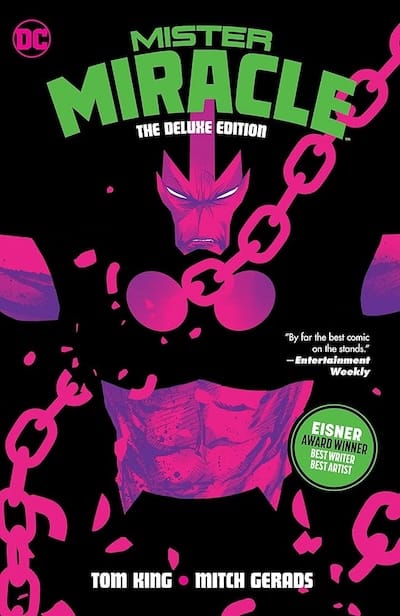
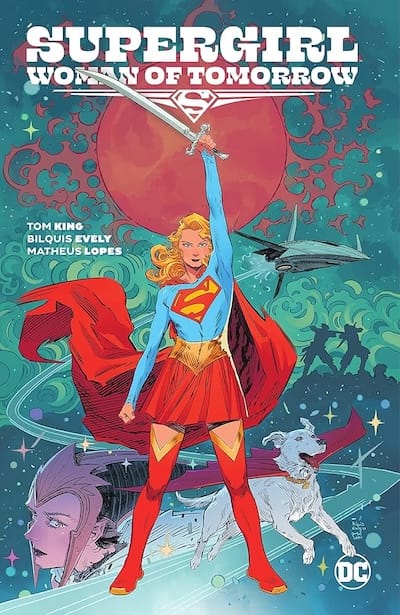
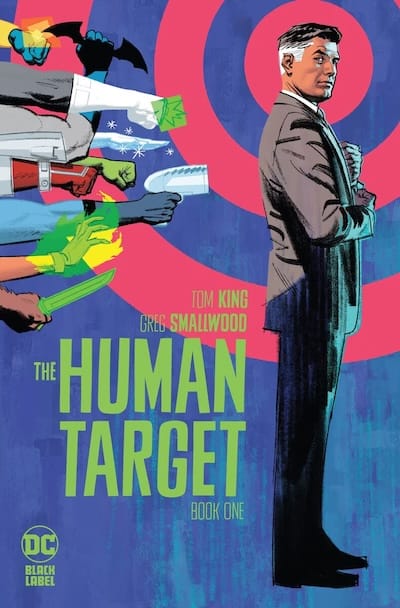
Three of Tom King's series for DC Comics. Art and characters (c) DC.
I'm not the biggest Tom King fan. I feel his first six issues tend to write cheques his last six issues can't cash. But at this point he has an extensive back catalogue of books that are at least trying something ambitious, that look good and are self-contained.
Case in point: his Supergirl series with artist Bilquis Evely, which is a sort of female-led superpowered space frontier story with Supergirl playing the part of stoic Rooster Cogburn to her companion's vengeance-seeking Mattie Ross. The series is only eight issues rather than his usual 12, but it is in my opinion the best thing King has written for DC.
Its vibe also proved to be simpatico with the movie slate at the James Gunn-led DC Studios, since it's a major influence on this summer's Supergirl movie starring Milly Alcock and Jason Momoa. The production and marketing budget of which is going to end up in the hundreds of millions of dollars, orders of magnitude bigger than the money tied up in releasing one single comic book series.
For DC, publishing stories with appealing modern takes on their characters makes sense. Having a backlist of reader-friendly collected editions makes sense. Publishing stories that readers will remember and want to recommend to each other makes sense.
So even from a purely "number go up" mindset, focusing on squeezing every possible dollar out of the existing Direct Market at the expense of putting in the work to cultivate a new audience is a pretty inefficient way to make the number go up.
There are stories from the 1960s of fans showing up at the Marvel offices unannounced and being given a tour of the place, but those days are long gone. To my knowledge you practically need to sign an NDA to be allowed on the premises now. Accordingly, I'm not going to pretend to know what's going on behind the scenes at Marvel. But "the purpose of the system is what it does" as the saying goes, and we can see what Marvel does by looking at what it publishes every month.
I will say that I have worked at companies that kept missing open goals because of bad decisions by management, and based on that experience I would speculate there are people at Marvel who are aware the company is publishing drek and would like that to change. The problem is unlikely to be a lack of talent: many of Marvel's creators also work for DC, after all.
Unfortunately, if you want to change a company's strategy from within you have to make a business case for the alternate approach. You have to be able to articulate where you want to be vs. where you are, how it's going to be better if you get there, and have some sort of metric that shows if you're succeeding or failing at getting there.
And for a company that measures its own success or failure in how much it manages to juice the short-term sales figures, that's a problem. Because recall, if you will, the beginning of this essay, where I listed things other than sales that can indicate if a creative work is successful. Most of those won't work for Marvel.
Awards and nominations. I'm a reasonably well-informed reader of comics but I still could not tell you what wins Eisner Awards. They're the industry's highest-profile award ceremony and the one friendliest to superhero comics but I would imagine their biggest impact on the industry is via attendees' hangovers on Saturday morning at San Diego.
Hollywood sale. This is difficult to achieve when the movie studio is part of the same corporation and already owns the rights to everything you publish (except in the Spider-Man comics). And given the recent "line go down" phenomenon at Marvel Studios the people there are probably more focused on getting their own house in order.
Critical acclaim. Oh man.
This is a genuine problem for the whole comics industry. Remember when there used to be a profusion of sites where people were paid to write about comics? When there used to be news coverage and thinkpieces and criticism? And when there were also sites that didn't pay but were run by fans and aspiring creators and that had a real following and published regular interviews and broad review coverage? Remember The Savage Critics and Newsarama and Ninth Art and ¡Journalista! and Comics Alliance? Remember The Comics Reporter? Remember Savant? (I mean, genuinely, I could be the only one at this point who remembers Savant.)
David Harper at SKTCHD does good work. Rich Johnston at Bleeding Cool still publishes the occasional comics article. Heidi MacDonald has kept The Beat going. There are a few more. But the first two of these basically represent one guy's opinion and tastes. They can't fill a gap created by the demise of the whole – I'm going to use a word you may not have heard for a while, brace yourselves – blogosphere.
There are many reasons why the devastation of online comics commentary sites is bad, but for the purposes of this essay, if I was someone at Marvel looking for a signal other than monthly sales that a new approach was working, I basically could not use critical acclaim. And the fact that it's almost impossible to have a public conversation about comics without being overwhelmed by chuds doesn't exactly help either.
Tom King's DC back catalogue didn't emerge fully-formed out of the preferences of the Direct Market. His first 12-issue series, The Omega Men, was published in 2015, a few years after The New 52 when DC was experimenting with trying new things. It debuted to disappointing sales and DC canceled it as of issue 7. But within a few days, Jim Lee announced that since the title had been so well-received by readers, the book would continue to issue 12 after all. A substantial part of their current publishing strategy was born out of that decision, and the forces that made it possible essentially don't exist now.
There was a jubilant tone to the coverage of last month's ComicsPRO event in Glendale, largely because the industry's main distributor had collapsed in the previous 12 months and the industry just... survived it. A lot of people, and I'm one of them, would not have said that was a sure thing.
But DC has found a publishing approach that works for them and is bringing in new readers. Having a company run by people who are willing to tend a productive environment makes a real difference.
But of course, the world is chaos and none of this might last. DC's corporate parent is in the process of being bought by another Trump-affiliated billionaire, and who knows what will happen after that? David Ellison might decide Absolute Batman is unacceptably woke and demand that Wonder Woman become a QAnon.
At which point it would be great to have a Marvel Comics capable of taking up the slack. But getting there would require the people in charge to make some big choices. Not necessarily hard choices, but big ones. I'm sure the Disney top brass, if they ever thought of it, would prefer to be publishing Marvel comics with general appeal outside the hardcore fanbase. Unfortunately, even though the people in charge of the comics division have internalised the vital importance of turning a big profit, their whole operation is such financial small potatoes that it's unlikely anyone at head office even gives them a second thought. Disney bought a movie studio and got a comics publisher by accident.
And so Marvel is locked into these bad patterns, publishing unloveable comics with zero shelf life.
The financial health of the comic book industry depends on what its two biggest publishers are putting out, and that's not great. Because until something changes, whatever Marvel Comics publishes is going to keep withering on the vine.